Around 1989, when I lived in San Francisco, I spent too much time in little rooms with transit advocates (and some transit professionals who could not be named) complaining about Muni Metro, the combined surface-subway light rail system. It looked like this and still does, except that the T line was added more recently. Note the r0ute letter names in the lower left.
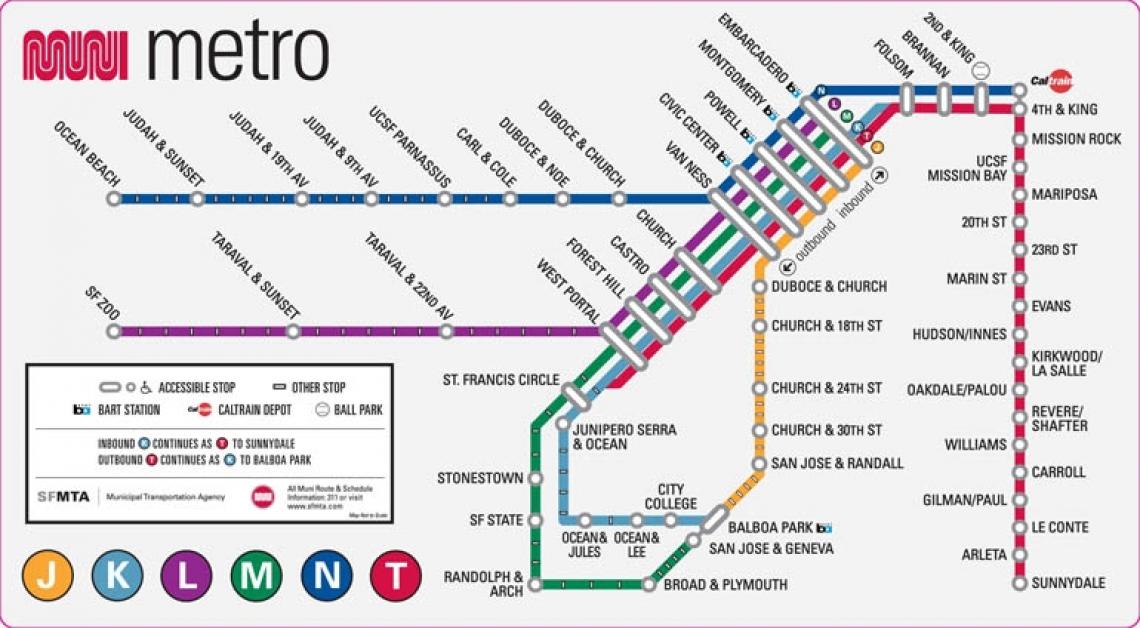
The segment with 3-5 lines on it, from Embarcadero to West Portal, is the underground segment, which carries the heaviest loads through the densest part of the city.
It had always been wildly unreliable. The five lines that ran through it (J, K, L, M, and N) always came in sequences of pure arithmetic randomness: N, J, M, K, J, N, N, K, K, M, N, J, L. (Finally, my “L”! But of course, after such a long gap, it’s crush-loaded and I can’t get on.)
Four decades after the subway opened, lots of things have been fixed: longer and better trains, better signaling, an extension downtown that helped trains turn back more efficiently. But none of this touched the true problem: The core Metro subway carries five lines, all of which deserve to be very frequent. But they can’t all be frequent enough because they all have to squeeze into one two-track subway. The other part of the problem is that they all have surface segments at the outer end, where they encounter more sources of delay, causing them to enter the subway at unpredictable times, and in an unpredictable order.
In those small rooms in the 1980s, we all knew that there was only one mathematically coherent solution. Some us drew the map of this solution on napkins, but we really didn’t need to. The map was burned into our minds from our relentless, powerless mental fondling of it. Of course it was politically impossible, so impossible that if you valued your career you would wad up that napkin at once, burn it probably, and certainly not mention it outside your most trusted circle.
At most you might let out the pressure as a joke: “You know, we *could* turn the J, K, and L into feeders, and just run the M and N downtown. And then we’d have room for a line that just stayed in the subway, so it was never affected by surface delays.” Everyone would titter at hearing this actually said, as though in some alternate universe such a change could be possible.
Now, the impossible is happening. Without fear or shame, I can finally share the content of that forbidden napkin, because it looks like San Francisco is actually going to do it.
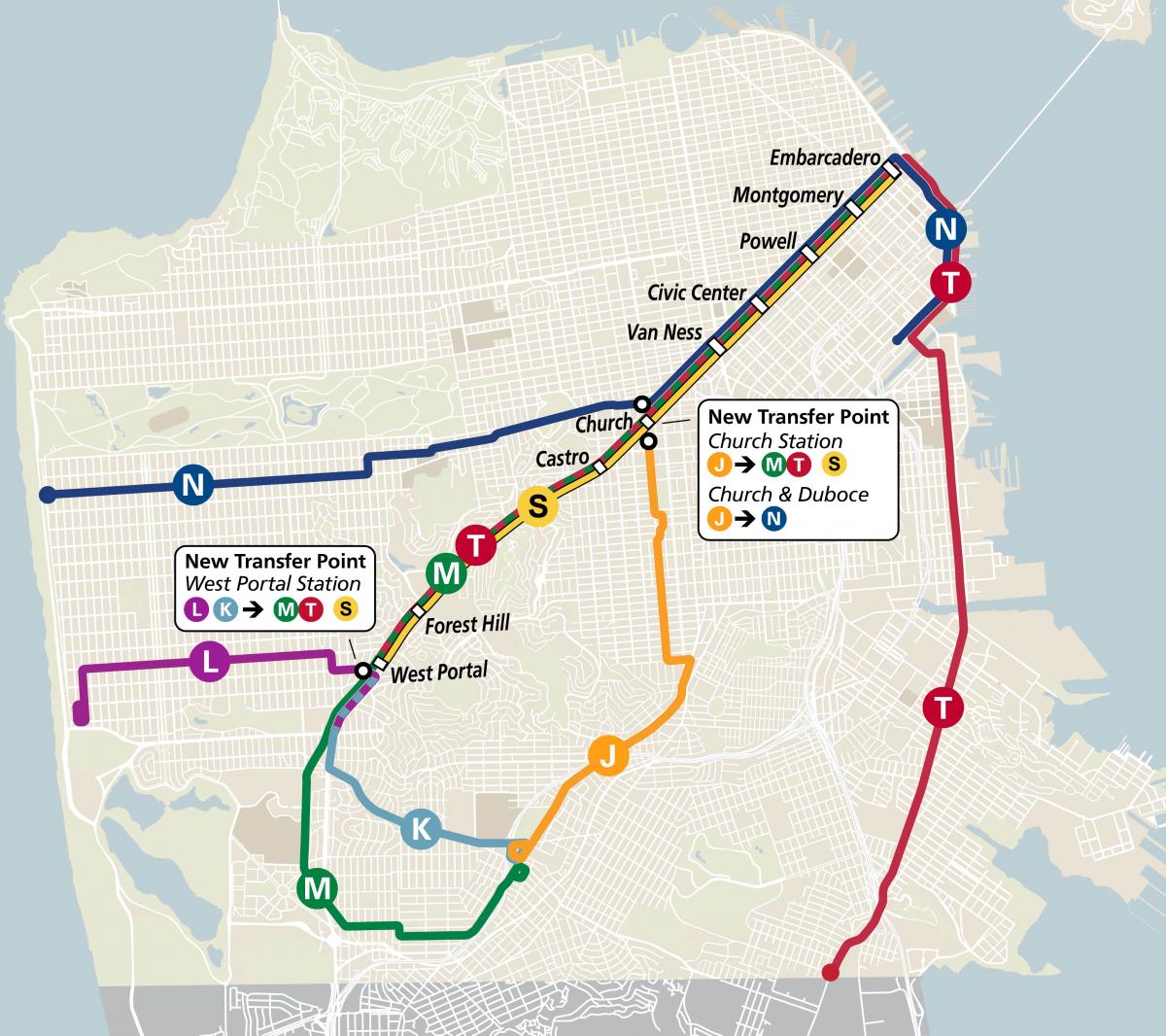
The two busiest western lines (M, N) will still go downtown, the others (J, K, L) will terminate when they reach a station but you have to transfer to continue downtown. M trains will flow through as T. Finally, a shuttle (S) will provide additional frequency in the subway, immune to surface delays. As always, asking people to transfer makes possible a simpler, more frequent, and more reliable system.
You may detect, at San Francisco’s tiny scale, a case of the universal “edge vs core” problem. Like many, many US rail transit systems, Muni Metro had been designed to take care of the edge, people who lived on one of the branch lines, rather than the core, people traveling along the subway in the dense inner city. The new system finally fixes the core. But the edge folks benefit from a reliable subway too. What’s more, in the future it may be possible to run the surface segments of J, K, and L more frequently, because their capacity will no longer be capped by the need to fit down the subway with four other lines.
All that in return for having to transfer to go downtown if you’re on the J, K, or L.
Let me not make this sound easy. These transfer points, West Portal and Duboce Portal, are a little awkward, because they were never designed for this purpose. You have to walk from one platform to another, crossing at least one street. There are valid concerns from people with mobility limitations, which will have to be addressed with better street and intersection design. Plenty of people won’t like it.
But the transit backbone of a major city will finally function. And for those of us who’ve known San Francisco for decades, that’s a forbidden fantasy come true.
A very bad change. Having a “S” route that only goes to West Portal will inevitably mean that these trains will carry less passengers than the other two routes, which in turn means that the M and N trains will be more crowded. That random sequencing shouldn’t be a problem if you just switch the signs on the trains when they turn around so that the trains always depart in a designed order, for example N-K-J-L-M, but that would require some operational hassles for the convenience of the passengers, which of course is unthinkable in today’s world.
Switching the signs to make the trains depart in the designated order costs more money though, because the union contract demands a penalty payment to the driver for having to drive other than their assigned route.
Wait, is that a joke or are you serious? That’s a totally absurd provision of a union contract
Traffic delays would make this impossible
Having a “S” route that only goes to West Portal will inevitably mean that these trains will carry less passengers than the other two routes, which in turn means that the M and N trains will be more crowded.
I don’t buy it. If anything, it will be the opposite.
Here is one way to think of this: imagine if every time they were going to run a J, K or L, they ran an S, but otherwise kept the schedules the same. The M and N run at the same frequency. If anything, the M should be less crowded, since riders trying to get West Portal now have more trips per hour there (since an S run replaces one of the J runs). Riders taking the N, meanwhile, benefit from fewer delays on the core line.
Next up, cut down the bars between the BART and Muni stations. Free the passengers!
The real obstacle there is the funding stream of BART vs. funding of Muni. But yes, a fully integrated regional transit system (beyond just clipper card payments) is sorely needed, and would really integrate/connect the full bay area, rather than remaining a weirdly balkanized patchwork of AC transit, ACE, Wildcat/Lynx, Muni, Caltrain, BART, VTA, SamTrans, etc.
But hey, 30+ years for baby steps is….progress?
https://www.seamlessbayarea.org/
In Boston, there are four branches in the Green Line trunk, and I don’t think the horrendous headways of Muni Metro are common. 1:4 splits aren’t common on subway-surface systems, but do exist (I think Düsseldorf has one), and 1:3 splits are pretty common – and over here the Stadtbahn networks are two-tailed, unlike the Green Line or SEPTA Subway-Surface or (for the most part) Muni Metro.
Frankfurt’s A-Line would be the German equivalent – 4 branches, peak frequencies 2×7/8 minutes and 2×15 minutes all terminating at Südbahnhof.
The Green Line has dedicated ROW throughout and signal priority (mostly or everywhere), does it not? Muni Metro has neither and runs as a streetcar (stop signs and waiting for cars to make left turns and all) on the outer portions of all lines.
Then give Muni Metro dedicated lanes. Problem solved.
Yeah, just move all the buildings back 15 feet so theres room for a dedicated line, no duh, why didn’t we think of that before….
No, make those streets pedestrian/transit-only. Not every street needs to allow cars!
Ped/Transit would be fine, but actually SF streets are generally pretty wide, so in many cases, basically no change is needed. The pavement is at least 60′ wide on Judah, Taraval, Ocean, etc. Maybe put up a curb at most to separate car lanes from transit lanes. Only thing that’s lost is the ability to double park.
Where there isn’t space, eg Church, just ditch the parking entirely. Boo hoo, have to put your car on one of the cross streets instead – cry me a river.
Even if you eliminated traffic, that still doesn’t mean the problem will be solved. Boston does have some headway issues and there may be more traffic lights here. There are also issues that Matthew alluded to. For example, take the M. For a large portion of its trip, it travels unimpeded by traffic (https://goo.gl/maps/2owxGqZwsGZJ59NE7). But as it gets further out, it has to deal with mixed traffic (https://goo.gl/maps/nKNPMSJmpYYXY36d7). As suggested, the first thing you do is eliminate parking, giving you space to run the cars adjacent to the streetcars. But you still have issues with cars turning left, which is by far the most unpredictable, and major delay for any vehicle. You could eliminate left turns (which in general is a good idea) but in this case, for that intersection, it would be very cumbersome. Normally, you would take three rights, but in this case, that can’t be done (because of the dead-end streets). So that would lead to trips like this: https://goo.gl/maps/Ee8FvX2NfuDFZAey6. These aren’t the end of the world (that’s life in the big city) but still not ideal. An alternative is to add more traffic lights, with left turn arrows (so that cars can cut in front of the trains) but that is a lot of extra work. Typically you want a pocket for left turning cars (otherwise they backup traffic) and now you are back to the starting point — the street isn’t wide enough.
I’m not saying they can’t improve the flow of the trains when running in streetcar mode — or even fix them — I’m just saying that wouldn’t be easy. Either you deal with political issues (due to a lot worse traffic) or financial ones (that involve widening the street). I’m guessing that while the trains carry a fair number of people in streetcar mode, that is not a huge portion of their ridership, or even a particularly large transit segment. Improving the flow of these lines would help those riders, but there are probably a lot more places (served by buses) that would be a better value. The main benefit would be to improve the flow of trains where they are really needed (in the core) and this plan does that.
Somehow SEPTA manages with 5 lines, and its streets are actually much narrower than MUNIs.
Do the trains run on those narrow streets and share traffic with cars? From what I can tell, the trains seem to run on independent pathways. San Fransisco has some of that as well (https://goo.gl/maps/Pp4QZ8YQ2bJDdzQy6), but the problem are streets like this (https://goo.gl/maps/hxggfRvRVSoJm7mJA).
Another issue may be that the frequencies are just not as good. Muni trains carry a huge number of people, and thus need to run often — especially in the core. I doubt that is the case with Septa.
Note that Muni was (before Covid) running a 1:6 split, since in addition to the five branches the ‘S’ shuttle has existed for a while and is not a creation of this plan as Jarret suggests (I’m not sure if there was an S back in ‘89). Also the Green line and Philly Sub-Surface lines split at one end only, while Muni Metro has branches on both ends (5 to the W, 2 to the E) complicating scheduling. Having branches is usually a good thing for utilization since the core is always busier than ends, but Muni Metro desperately needed some pruning and rationalizing.
The real problem with Muni Metro is that at Embarcadero, turning trains get in the way of trains proceeding past Embarcadero to 4th and King. Five lines would be a lot more tolerable if *all* the lines terminated in the same place (SEPTA) or if terminating trains got out of the way of non-terminating trains (Boston Green Line) or if they ran through and terminated at different branches.
Track map for reference: https://www.nycsubway.org/wiki/MUNI_Metro_Track_Map
Would the l and k lines turn into s trains?, Or are they really just turning around two trains at the West portal station?
The L and K trains are through running as each other, from Balboa Park to the Zoo. ‘Turning into S trains’ is what the system formerly did, when all lines entered the tunnel.
It actually looks like L and K trains are through-routed with each other, though I don’t know for certain.
That’s what I saw when the original announcement was made.
The whole thing has me picturing the next step as getting actual low floor cars for J K and L.
Yes, L and K will be one line. S stays in the subway (thus not affected by surface delays).
I could see value in having the J connect to that line as well, although that would likely make that line very inconsistent. In general this pretty good in terms of length (for surface areas).
L become K
I remember several years back reading about muni potentially reworking their surface tracks on market street in order to allow for surface running when the tunnels are out of service..
I think the plan is for the most part rational, but it irks me that the J can’t continue along market on the surface. I mean, maybe it wouldn’t provide a huge amount of benefit since people would transfer anyway, but think of it as ‘throughrunning the F and the J’, or something (yes I know the F is streetcars) but why the transfer?? crosstown service on the K and L makes more sense to me than tantalizingly close to downtown radial service.
Market is served by trolleybuses, which require two wires (to complete the circuit; on streetcars and LRVs the rails serve as the return for the circuit). The LRVs used on the MUNI Metro use a pantograph, which doesn’t work with two overhead wires, since it would just create a short circuit between the two wires without powering the vehicle.
That might be the case for the setup in San Francisco, but in my hometown Innsbruck the (now defunct) trolley buses had no problems sharing the road with pantograph using trams. The trolley wires were set up a little higher, and the junctions were a little complicated, though.
SEPTA’s subway/surface has 5 lines – the 10 which surfaces via the 36th St. portal and the 11, 13, 34, and 36 which use the 40th St portal.
50 cars are scheduled during the peak hour.
Operations for SEPTA S/S are pretty similar to MUNI metro with the streets in Philly being a lot more narrow. The major difference, for now, is the rolling stock and ridership.
The real workhorse in Philly seems to be the loop under City Hall – where all trolleys turn without stopping. Muni still needs to fix the priority problems in the Sunset (as does SEPTA in West Philly) but a loop under Embarcadero/Harry Bridges Plaza seems a needed, long term solution. Easier in this case than what was done in Philly long ago as the Plazas in SF have no buildings atop them and BART is already well below Muni grade at that point.
I think this new plan has promise. I grew up half a mile from the K, an easy long walk, and liked the general notion of a 1-seat ride downtown, but it was neither fast nor frequent. While you were waitng for the L, I was waiting for the K (but had the option of exiiting at Forest Hill, catching the 43, and walking downhill 3 blocks vs. uphill 6 blocks to home). The current system might work better if the downtown supervisors would/could reassign inbound cars to outbound lines in a set order, but operators typically have a full day’s printed schedule clipped to their visor, so it would require changing the way things are done). MUNI doesn’t havae the 2- or 3-track terminal loops that Portland has, so any train can leave next. Another dream would be for the Embarcadero extension to feed several short branches (inclluding north of Caltrain or leaping over it, if only to the foot of Potrero HIll or the inner Mission and far SOMA) so the Market Street subway has dispersed terminals at BOTH ends (but you’d still a random order of trains). Given things as they are, this plan is interesting. The K-L runthrough is awkward in terms of actual disembaraking but maybe bulb-outs on Ulloa would be best (2 lanes to cross, maybe transit-only, quick-build wheelchair ramps in front of the old BofA and library).
This could mean that the “street” routes could use low floor vehicles – improving accessibility!
The high floor “Muni Metro” vehicles would then only serve high level platforms…
Hopefully this become permanent.
Interesting idea! They will probably prefer the interoperability that comes from having a consistent fleet, but you could suggest that to SFMTA.
This was proposed years ago by a transit enthusiast. http://newmunimetro.com/m-market/
Would it be possible to combine the J, K, and L into one circumfential line? Can’t remember if the setup at Balboa Park allows through-running. If so, would it be desirable? It would provide a one-seat ride around the south part of the city, though maybe it making the line longer on the surface section would make it harder to maintain headways.
My main complaint — and this is surely a product of the same political pressures that have made it so hard to do this kind of redesign in the first place — is that maintaining the traditional line letters and names makes the network much harder to understand at a glance, a gripe I’ve always had about the interlined K/T situation. I get that keeping the names of individual branches is valuable, but why not at least have the trains labelled with a double-letter name for their whole route, instead of having you get on an M train that abruptly becomes a T after a few stops.
And looking at the wye near West Portal definitely makes me curious how they’re going to set that up for transfers. Looks like they’ll definitely need to build some new platforms and change traffic flow, which is pretty wild considering the new configuration is only two months away. I guess it helps that they aren’t currently running any trains!
Shorter reply than my long ramble – a qualified yes, yes, yes. If the combined JKL turns from Ocean to San Jose Ave (with a new curb-side stop eastbound on Ocean, using the existing southbound platform on San Jose) it’s a lousy, 1.5 to 2.5 block walk over to the BART entrance, but a MUCH more useful run-through, one line that actually goes somewhere. Plus the M could have a dignified terminus at the current J/K platform at the BART station.
My guess is the issue would be reliability. These are the segments that have been cut from the main line, so they are probably the inconsestent. The longer the line, the less reliable it is. Otherwise I think it would add value, as the turn from K to L is more acute than the one from J to K (making J to K otherwise a better pairing).
For the core vs edge situation, the parisan RER is quite similar. The multiple branches of the line A combine within Paris to disperse outside (3 branches to the West, 2 to the East).The reliability of the line is not impressive, to say the least. It’s been improved by recent works, only to rise from abysmal to rather poor. I guess the reason is very similar to the one described above.
The part common to lines B & C, between Gare du Nord and Chatelet-les-Halles, also caused me a lot of headaches when I was living here. Having the choice between both lines is cool in hours with light traffic, but when it comes to rush hour, it creates often traffic troubles.
https://www.chezbertrand.com/metro-bus-paris/plan-rer-paris.html
At a much smaller scale, I can see the same phenomenon in Montpellier where I live now. The areas common to many lines, like Saint Roch (1, 2, 3, 4), Corum (1, 2, 4), Rives du Lez/Moulares (1, 3, 4) are always places where the tram is slower than pedestrian – for regulation reasons.
https://fr.m.wikipedia.org/wiki/Fichier:Montpellier_tramway_map.png
the future line 5 will also have overlaps. With the line 4 (which highest frequency is 9 minutes, so it should work); and with line 1 (with 5 minutes frequency, and there we have a problem. The dubbed part is one next to the university area, one where the 1 is overcrowded. I guess the plan is to allow more students to travel on this part. I fear the risk is to make the travel here even a worse experience).
https://actu.fr/occitanie/montpellier_34172/tramway-le-trace-de-la-ligne-5-devoile_23213171.html
I only really know central Paris and that only as a yearly tourist. Last fall I saw the beginnings of the serious bike-ification of Paris with excited anticipation. The recent expert use of the twin crisisies (crisi?), that is the transit strike and the pandemic, by Hidalgo, seems to have effected a true paradigm shift, at least according to my personal limited twitter feed. Granted I’m too old to really use and appreciate it, but intellectually I’m excited by it.
Anyway, I wonder if such a shift say in the university area might relieve the overcrowding you describe, and more generally what the changes portend across the transit system.
Through-running the K and J might make sense, but currently both run all around the Geneva yard at 5 mph (after an interminable wait to turn off Ocean on a tight, steep curve, then an interminable wait to return to the street. At least there’s finally a disembarkation platform. Putting a platform somewhere on Ocean near the new back entrance to Balboa Park BART might make it possible to stay out of the yard and MUNI platform altogether, and just turn from Ocean to San Jose Ave, but the connecting buses mostly stop on Geneva and the platforms sorta kinda have wheelchair access. The M terminus at Balboa Park is just as bad–arriving passengers must disembark on San Jose Ave. (no platform, no nothing, then the train dives into the old Geneva yard, circles back out to the street to pick up departing passengers at a small mid-street platform with a non-standard wheelchair lift. It’s a half-block walk from BART. Had MUNI not built their electronics shop and offices right in the exit to Balboa Park station there might have been room to reconfigure the BART-side platform but nobody was thinking well about ADA back in 1978, nor terminating three lines (when the extension opened to passenger traffic in the ’80s I think it was just served by the K). Bridging over I-280 has been proposed but nobody’s really drawn a sensible, better terminus, just renderings with glass roofs (ain’t gonna cut it).
Is there any merit to matching the J & N with a forced transfer at Church, or is there too much demand imbalance between the two branches?
The N serves UCMC, the second largest single destination west of Civic Center after the M’s SF State. It needs access to the buses serving north-south routes east of Church.
A: Letters in circles remind me of N Y C subway- elevated lines. B: What are headway minimums in subway tunnel? C: what is the capability of creating some express track ways as per NYC and SEPTA` B S S? M-F-S-E with sub.-surf. between 30th & Juniper (13th – City Hall) also is a sort of local-express system. ==Blue Line has no stops between 15th & thirtieth and in fare control free transfer while Green Line(s) have two intermediate stops. ?= Tunnel-underground stations are ‘fare controlled’ ones?
Question? Are the tunnel stations two births as per s-s SEPTA green lines?
If you’re asking about San Francisco subway stations, most are 4 cars long, but Forest Hill is just 3 cars long and the front and back doors overhang into the tunnel (so when 3-car trains were routine in the Boeing LRV days the driver opened just the middle doors – the Breda cars have front and rear doors usable at high platforms and I don’t know how they’d solve it with the Siemens cars). The new T subway that opens in 2021 has just 2-car platforms, which already makes me claustrophobic.
Powell and Montgomery are built at one end of the longer BART station cavern (which are 10 BART cars long) so MUNI’s handicap passengers using the elevator at the end of the station have to go through an unfinished “industrial” zone with gray floors, gray walls, ventilation fans, mysterious holes, steel handrails and noisy trains whizzing past. Would not fly if designed today.
The j church didn’t go to Balboa Park in 89 too
Can’t wait! Remind me of http://newmunimetro.com/m-market/ Let’s make that full plan happen
If Balboa is ever connected to the T line via Geneva, you could have a single circle line combining K and T. Not sure what advantages might accrue from that, but it’s a thought. Would feed density of Geneva/Bayshore area, for better and worse
We should make S more frequent, reliable and reduce mixing it with surface lines. I suggest that instead of the MT line, combine NT line for continuous service between Sunset, Downtown, Mission Bay and Bayview. J should combine with the M and terminate at West Portal. This will simplify and increase reliability on the entire system, and the S becomes a real subway line.
Um, how old is this article? It shows this past week however the S has been a reality for at least 16 years. It once ran specifically from Castro to Embarcadero only. When the T was added there was a ton of congestion underground. Thats when they widened it to include Forest Hill and West Portal.
At one point they also tried 3 car trains but that didn’t last very long.
How will the new central subway play into this? Have there been any studies of building a tunnel to extend the J north from Church to Presidio/Fisherman’s wharf area?
Late to the party and I can see from the number of posts that many small-room-type people are excited. 🙂
*I* am always amused that the two systems that ran Boeing *STANDARD* light rail vehicles (“standard” because it was perfect in every possible way) both have systems that have a tunnel in the core with surface lines at the periphery but more importantly, have non-overlapping routespaces! A (long gone), B, C, D, E (truncated now) on the MBTA, J, K, L, M, N, and the relatively recent T on SF Muni.
I often wonder if F, G, H, and I were reserved for SEPTA’s Subway-Surface lines but never got applied because SEPTA went with Kawasakis (to let the good times roll) when they replaced their PCCs …
The 70s were an odd time … 😀
I see no reason for the M to continue to Balboa Park. It just a more relatively low-density, higher car ownership market there in Oceanview. End the M at SF State, then extend the J.
Good match of market, but those same autocentric NIMBYS vetoed the idea when Muni floated it a couple of decades ago. Certainly worth trying again. If done, the St Francis Circle station should be raised as well as the Ocean Ave stop on the private ROW. Why? Keeping the steps up for the entire route is just more efficient, and the fewer times they are moved the longer time between failures.
This is why in Seattle, Sound Transit should force a transfer between East Link and the main line, rather than interlining it to the north and depriving the poorer and darker south end of service.
East Link won’t deprive the south end of service. There will be a split, with half the trains heading south, and half the trains heading east. The south and east trains are limited to six minute headways any (because they run on the surface, and the respective cities don’t want them running more often because they have signal priority). The combined lines (from the International District to the north end) will run every three minutes. The combined section is grade separated, and has headways that could actually be better than three minutes. So the split doesn’t actually cost anything in terms of reducing frequency to the south end.
The big change comes when the new tunnel is built, and the new lines are built to Ballard and West Seattle. At that point, the south end trains will go to Ballard, instead of the north end. East Link trains will still go north, and the West Seattle trains will go north. At that point, in my opinion, the South End will see a degradation. Instead of Rainier Valley trains going to Capitol Hill, the UW, Roosevelt and Northgate, they will go to South Lake Union, Lower Queen Anne, Interbay and Ballard. The former are much bigger destinations than the latter. South end riders will be asked to transfer if they want to get to Capitol Hill and the UW. Hopefully this transfer will be fairly easy, although Sound Transit’s record when it comes to transfers isn’t great.
In any event, this is not the worst failing of Sound Transit, nor the least just. It is building things like a very expensive line to West Seattle that only marginally helps folks on the Delridge corridor, while ignoring the much larger group of riders in the Central Area that could be served by a subway that more or less followed the 8 bus route.
Background, Muni used to couple/uncouple trains at the portals in order to achieve throughput when Embarcadero was a stub terminal . For reasons lost to time, coupling/uncoupling became impossible in San Francisco outside of the yards (despite functioning worldwide). (there was also the issue of trailing car operators “reading magazines” as they had no actual work in the tunnel.) And, yes, the Muni union contract does mandate premium pay for route reassignment.
When Muni built the Embarcadero extension (T and N service to 3rd St and Caltrain respectively) no loop was built–merely pocket tracks.
When the Breda fleet displaced the Boeings, the deal with the unions became 2 car trains coupled in the yards with a single operator would be run on heavy routes–singles on others. When Muni installed early ATC, actual throughput decreased. Supposedly upgraded ATC still cannot operate the advertised schedules.
As to the mess at Embarcadero, here again, Muni chooses not to operate w/ fallback crewing, and has made no effort to get rid of the premium pay silliness in favor of straight time, route as assigned.
About dedicated lanes, the N Judah has a short section of raised concrete trackway, but occasional drivers use it. At the time it was built, more was planned,but the NIMBYS passed out many torches and pitchforks. In the last year Muni has tried to get a few blocks of dedicated lanes on the L but has met stiff resistance from both residents and merchants. Muni has floated extending the J to SF State, but the neighbors freaked out at having a train on a track in the street median; so the Ms still run mostly empty between there and Balboa.
So, here we are in the 21st century barely exploiting “multiple unit control” invented in 1898 for streetcars in Richmond VA.
The new plan is a disaster for any disabled riders on either the L or K and no bargain for the rest.
As to re-routing the J onto Market St, MUNI is in delivery of many more cars from Siemens; surely having 24 trolley pole equipped (usable on ALL lines ) units for the J which can be covered by 12 with a 100% spares ratio.
In theory, the Central Subway will be in service within another year which will remove the T, tunnel traffic can then be more rationally operated.
Getting TWU to agree the necessary changes in contract terms will not be a cakewalk, but, bluntly, is far fairer to riders than the proposed service degradation.
Well, I have no stake in this particular service, and I haven’t seen the origin-destination data, so I couldn’t speak specifically as to how I’d view this change from the perspective of a planner. If there isn’t the capacity to run all the lines through the subway, then there’s that.
That said, the Market Street segment likely contains so many activity centers that it is something I would term as a linear hub. So my guess is that a majority of pax do travel between the surface segments and a station on the subway segment. Which means forcing transfers on these riders is highly problematic. If I were Muni planners, I would try and see if just one route could be taken out of the subway segment first, and see if that improved the reliability sufficiently, before trying to force transfers from additional lines.
Good match of market, but those same autocentric NIMBYS vetoed the idea when Muni floated it a couple of decades ago. Certainly worth trying again. If done, the St Francis Circle station should be raised as well as the Ocean Ave stop on the private ROW. Why? Keeping the steps up for the entire route is just more efficient, and the fewer times they are moved the longer time between failures.
I shall speak very much off tangent here, but why on earth is the T not joined to the other lines barely a few tens of miles to its west of its southern endpoint? Seems like a very large gaping hole in the network. I definitely wouldn’t want to live there if I could.
Frankly,because transit spending in the Bay Area is extremely patronage (political, not rider) driven. The value of filling in of the circle including a joint station with Caltrain is obvious–thus unseen. This is the city which is years late finishing a grossly misdesigned subway whose contractors installed a lower grade of rail that no one(?) noticed until all of it was in place.
Passengers having to transfer from one to another? Crossing the street? Sthg would have to be done to assist those with limited mobility?
What city is this?
What country is this?
Just build more tunnels. Yours is the richest country on this Earth. Join the 21st century for goodness sake!
this looks good! We’ll see how it works
Update. Muni showed its incompetence when the “new routing” started up. Apparently no efforts were made during shut down to check the overhead for problems. see
https://sf.streetsblog.org/2020/08/25/muni-meltdown-blamed-on-covid-staff-shortage-faulty-parts/
So, back to buses.
FWIW, many transit rail ops run ‘test trains’ even during strikes to find problems.