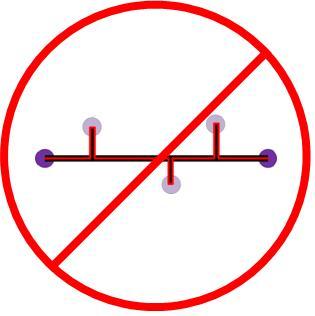
 One of the problems with discussions of Transit-Oriented Development (TOD) is that the term sounds much too specialized. We hear talk of TODs as a special class of developments with special requirements and possibilities, and perhaps requiring special expertise. We often hear that a certain development is or isn’t aTOD, as though transit-orientation were not — as it obviously is — a matter of degree.
Moreover, most of the urban development decisions that will determine the future viability of transit are not decisions about TODs. Most of them are not even conscious decisions about transit. The literature of “how to build TODs” is useless in these situations. What people need are simple guidelines about transit that they can keep in the back of their minds, and on their checklists, as they plan ALL kinds of urban development. The same principles could help institutions and individuals decide where to locate.
As a transit planner, I constantly encounter situations where something has been built in a way that precludes quality transit, where I can see that if it had been built a little differently, transit would have been possible without compromising any of the development’s other goals. I’ve also dealt with situations where a transit-dependent institution — say a social-service office catering to low-income people or an assisted living center for active seniors — chose to locate in a place where the land was cheap because the transport options were terrible, and then blamed the transit agency for not running buses to their inaccessible site. These cases are the result of a poor respect and understanding of transit as a background consideration in all urban development. Ultimately, they matter at least as much as the official TODs do in determining the potential for transit in the cities of tomorrow.
If I could put one sentence about transit in the mind of every developer, every land use planner, indeed anyone who makes a decision about where to locate anything, the sentence would be this: Be on the Way! If you want to be sure you’ll have good transit, be on the way from one transit destination to another.
 An efficient transit line — and hence one that will support good service — connects multiple points but is also reasonably straight so that it’s perceived as a direct route between any two points on the line. For that reason, good transit geography is any geography in which good transit destinations are on a direct path between other good transit destinations. (Obviously, this is not always a geometrically straight line; it may be a path defined by existing roads or rail corridors that everyone perceives as reasonably direct given the terrain.)
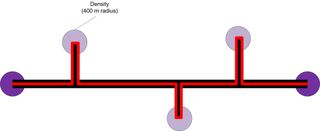 A bad geography is one that indulges in cul-de-sacs on any scale: It sets destinations a little back from the line, so that transit must either bypass them or deviate to them, where deviating means delaying all the other passengers riding through this point.
The same problem arises at many scales:
- A person who lives at the end of a long cul-de-sac road complains that the bus doesn’t go by her house.
- A small shopping center or grocery store sets itself too far back from its street, even though the street is where the transit service is.
- A university, hospital, business park or other campus-style development positions itself on a hill, often at the end of a road leading only to it, or on a road at the edge of the city where there is nothing further beyond it. This makes the institution look and feel important, but limits the possibilities for transit service because it can only be served by lines that end there.
- An entire suburb, perhaps one called a Transit-Oriented Development, is located in such a way that no regionally logical transit line will ever get to its town center, except for routes that go only there. One of the major failings of Peter Calthorpe’s early 1990s project Laguna West, in Sacramento, is that the town center is located in a place where no regionally logical transit line could ever serve it. Laguna West still has mediocre transit service because it’s impossible to combine its market with any other markets, which is what you have to do to create an efficient transit line.
Land use planners urgently need simple tools to catch these problems. Until those tools are developed and built into training, they’d do well to just remember one sentence: Be on the Way!
For more on this, see a fairly populist article I recently did for a sustainability workshop in Australia’s national capital city, Canberra. (The article also covers the whole transferring issue, but you can skip over that because you’ve already read it here.) If the article is too many words, there’s also a Powerpoint. Your feedback on this work is especially welcome, as this is becoming an obsession for me. If you’ve encountered other good work on this topic, I’d love to be pointed to it.
Your graphic with the cul-de-sacs reminds me of Long Beach’s “Passport” downtown circulators–small 30-foot buses whose main function is to connect LB’s business district with some rather far-flung tourist destinations like the Aquarium and the Queen Mary. What the city ended up with was a bus that took a circuitous route all over the place, with cul-de-sac stops to try desperately to bring transit to locations quite far from any pre-existing bus route or arterial street. Often, these cul-de-sacs required left turns at long signal-controlled intersections. In one case the bus would actually detour nearly half a mile in the wrong direction to serve a little-used stop before returning to the rest of its route. The buses are often full, but I think the sizable free-fare zone has a lot to do with that, as they are a true pain in the @$$ to ride.
I’m sorry this post has not received more attention because I think it is likely the single most important idea you’ve presented here. The development potential of streetcars seems very small minded when compared to the greater question of how to improve the mobility of communities at large. I have been impressed that some of the strongest transit corridors in Seattle are not those that strike me as particularly Transit Oriented. Rainier and Aurora Ave for example are full of linear, strip mall like developments that we love to hate. Granted there is not a lot of parking between the roadway and the shops but it is also true that the pedestrian amenities are not particularly good. I’ve also been impressed with the number of automotive shops and dealerships, at least on Aurora. I think we could do a lot more good for transit if we worried less about specific densities, or TOD design and more on simply being on the way…placement of parking, whether between the roadway and store entrance is really the same issue – being separated by a large parking is not being on the way.
Keep pushing this common sense approach.
Absolutely crucial point. (And I’m swearing about the way in which my local university has chosen to close bits and pieces of roads — somehow they broke all the through routes, so that any line running through has to make crazy turns….)
Fully with you Jarrett on this. In British Columbia we see examples as you described. The problem is a real disconnect between location and transit. It’s not so bad now, but look at where universities are located in BC. UBC is at the end of a Point of land requiring long trips through leafy expensive and low density neighbourhoods to reach campus; SFU is located on top of a mountain and buses have a hard time getting up it, crawling up loaded down with students commuting up from the SKyTrain station at the bottom; Capilano College on the North Shore – in a canyon on the side of a mountain on the way to nowhere; UNBC in Prince George, on a hill outside the city and away from where students want to be, so now BC Transit has to run buses to campus until 3:00am (if they’d built it downtown, students could stagger home and the city centre would have some life); and Kelowna – the university is somewhere north of the city again, on the way to nowhere.
And where I live, schools are located on farmland surrounded by farmland, and one wonders why there’s no or poor bus service to the school.
It seems to me in my part of the world, the government is the worst offender. And considering governments also approve land use changes, they’re also responsible for poor planning in this area.
I live in Staten Island, NY, and there is a nearby college with a fairly large campus that is well-served by public transportation. The reason is that there are 2 components to their transit system-local buses that go to the main entrance of the college and shuttle buses that go from the main entrance to the different buildings.
Great post! One of the worst examples I’ve seen of transit agencies not paying attention to this is the practice of spending millions of dollars on fancy transit centers with lots of bus bays and shelters, yet forget the be-on-the-way principle when designing and locating it.
The result is a situation where buses that serve the facility have to take circuitous detours and endure long waits at traffic signals to get in and out of the bus bays in a way that accomplishes nothing except to make everybody’s trip slower and waste taxpayer money to pay for the facility and the extra service-hours of maneuvering buses in and out of it.
Stephen is making lots of sense.
While he cites Rainier and Aurora as poorly built corridors, they also are the two highest (!) bus-ridership routes in Seattle. That tells me people will work hard to use public transit, and the onus/blame is on the governments that it’s not easier.
Seattle is, in fact, doing some of this at 130th/Aurora with dense senior and social housing, along with sidewalk and greenery improvements. But the progress is too sporadic to keep up with latent demand.
Mike Lindblom
Seattle Times transportation writer
This may be a worse example of “not being on the way”, from my neck of the woods. http://en.wikipedia.org/wiki/Klang_Sentral bus terminal.
Closing a bus terminal in the town centre, and moving it out 9km to the north of the town. Whereas the main bus routes are actually towards east of the town.