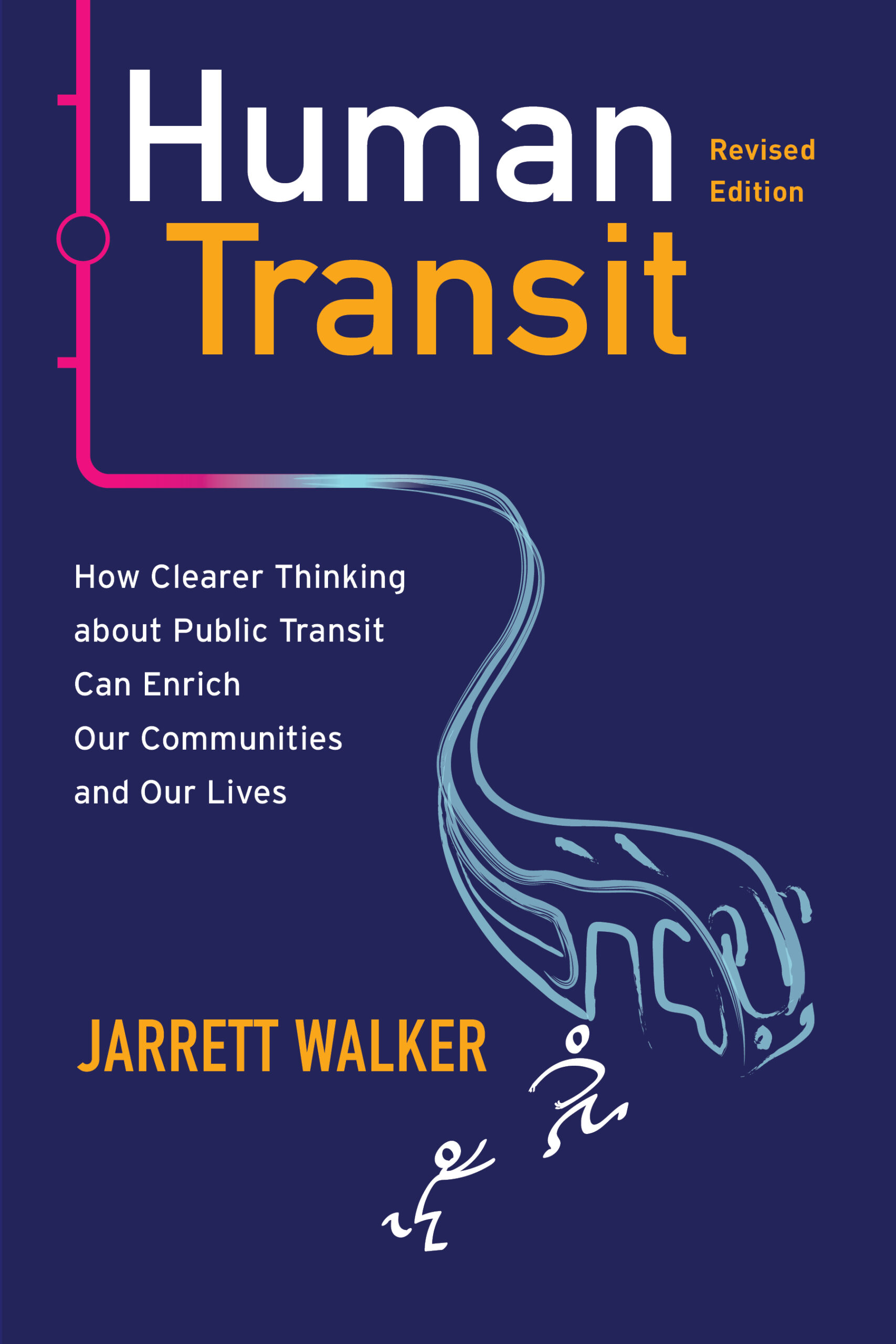
Below is the complete introduction of the Revised Edition my book Human Transit: How clearer thinking about public transit can enrich our communities and our lives. You can read the preface and Table of Contents here. You can find the book at Powell’s, Amazon, or your favorite retailer.
Introduction
Cities don’t function if everyone is in their own car. It doesn’t matter whether people are driving or being driven. It doesn’t matter if the car is electric or automated. A city is many people living close together. That means there is relatively little space per person. Cars take up lots of space per person, so there isn’t room for them all.
As a result, we get in each other’s way, frustrating each other’s lives, in the phenomenon we call traffic congestion. But the problems caused by car dependence go far deeper. They include fatalities and injuries, an ambient massacre of the innocents that we are expected to treat as normal. They also include profound contributions to pollution and climate change. Electric cars will help, but they are still more energy intensive, and rely on more polluting processes per passenger, than public transit does.
In cities, we need to move a lot of people in a small amount of space. Walking is always the best choice, for those who can. But once we must travel beyond our walking range, there are two options. We can use devices that help us travel without using much more space than our bodies take. This is the domain of micromobility or person-sized vehicles: bicycles, scooters, skateboards, and so on. Or, we can gather in larger vehicles that will carry many of us efficiently, which is the core idea of public transit.
But public transit has another role, even where space isn’t an issue. Many people can’t drive, and many people shouldn’t be driving. If you can afford it, you can hire someone to drive you, but many people can’t afford this for the amounts of travel that they need to do. For these people, transit is the foundation of their ability to reach all the opportunities that they need to create a better life. This is why some public transit is often provided even in rural areas, where the efficient use of space is not an issue.
The frustrations of urban transport have fed a growing public interest in public transit in many countries. But when well-intentioned people look at the public transit around them, many conclude that it does not make sense for them to use it. There are many good reasons not to use public transit. It may not go where you need it to go, or at the right time. Perhaps you can get there three times faster by driving, or at half the cost. You may know from experience that you can’t trust your service to come on time. The vehicles and staff may fail to meet the most basic standards for civility, safety, and comfort. Your transit network may be too confusing, requiring you to wade through too much detail to figure out whether the service is useful to you.
Even if you decide that you can’t use it yourself, you may support public transit in hopes that someone will use it, because there is obviously not enough room in your city for everyone to drive, or enough space to build more freeways and to widen streets. You may also understand the many kinds of long-term harm, to people and the environment, that arise from too many cars and too much pavement. You may even fear that driving your car while wanting fewer cars in your city is some sort of hypocrisy on your part. (Often it’s not. You may live and travel in an area that’s been designed in such a way that no reasonably efficient transit can ever provide you with useful service.)
These common frustrations explain why, in many urban regions, support for public transit is wide but shallow. Voters typically support transit in general, but most don’t know how to decide whether a transit proposal is good or bad. They may want better transit for themselves or their communities but have no idea how to make it happen.
For this reason, too, it’s easy to create distractions in the public transit conversation. There will always be new technologies for sale, claiming to be “disrupting” or “transforming” public transit. Some of these ideas seek to spare us from sharing a vehicle with strangers, and as a result they end up looking a lot like cars. An elite figure like Elon Musk can say that transit is terrible because it involves “a bunch of random strangers” but as I’ll argue, bringing strangers together to share a ride is exactly how public transit succeeds.
What is quality public transit? Who can realistically expect to be served by it? What kinds of quality matter? How do we recognize and nurture them? What are the goals we want transit to achieve, and how do we navigate tough spots where these goals conflict?
Debates about transit proposals commonly lose track of these questions. Too often, we defer to a small group of intensely interested people (such as developers, activists, neighborhood groups, labor unions, and purveyors of transit technology) because the debate seems too technical for most of us to follow. As a result, we sometimes end up with transit investments that don’t really do what we expected, or that have side effects that should have been foreseen.
Transit debates also suffer from the fact that our leading decision makers are especially likely to be motorists. No matter how much you support transit, driving a car every day can shape your thinking in powerful, subconscious ways. For example, in many debates about proposed rapid transit lines, the speed of the proposed service gets more political attention than how frequently it runs, even though frequency, which determines waiting time, often matters more than speed in determining how long your trip will take. Your commuter train system will advertise that it can whisk you into the city in 39 minutes, but if the train comes only once every 2 hours and you’ve just missed one, your travel time will be 159 minutes, so it may be faster to drive, or even walk.
I can explain the concept of frequency to a group of well-intentioned leaders, and they may understand why it’s important. But what they know is the experience of driving, where speed matters and frequency doesn’t. So when they make a decision about a transit project, they are likely to give frequency too little weight. The result can be services that are very fast but don’t come when we need them, or that require too much time to connect from one service to another.
The unconscious assumptions of motorists are just one example of how people try to think about public transit as though it were something else. Everyone tries to translate a question into terms that they understand. Economists may talk about transit in terms of profitability, as though that were its goal. Equity or social justice advocates think of it as a tool for meeting the needs of people who have been excluded or marginalized. Architects and urban designers care about how it feels to move through a city, so they often focus on the aesthetics of the transit vehicle and infrastructure. Urban redevelopment advocates categorize services according to how well they stimulate development.
None of these perspectives is wrong; transit can serve all of these interests and more. But to achieve that broad level of service, these points of view have to be brought together into a clearer conversation.
To aid that conversation, this book aims to give you a grasp of how transit works as an urban mobility tool and how it fits into the larger challenge of urban transport. This is not a course designed to make you a qualified transit planner, though some professionals will benefit from it. My goal is simply to give you the confidence to form and advocate clear opinions about what kind of transit you want, and how that can help create the kind of city you want.
Who is the Public? Who is an Expert?
When our elected leaders make decisions about transit, they face a noisy mix of competing interests. An older adult has trouble walking to a bus stop, so they want the stops placed closer together. Others want the bus stops farther apart, so that the buses run faster. Some merchants want the bus to deviate into their shopping center, to bring customers. Other merchants oppose the bus service to their shopping center, because it’s bringing “undesirable” people. Suburb A wants a proposed rail transit line to go underground through their community, to preserve their ambience. Farther out on the proposed line, Suburb B wants the whole line elevated, so that the line is cheap enough to get all the way to Suburb B in its first phase.
Transit professionals are not always in a position to clarify the debate. Some of them lack a sufficiently broad view of their product or have been trained to think only about one aspect of it. Many more have the understanding but lack the confidence. Even worse, professionals working inside public transit authorities often find their time consumed by daily crises and controversies and simply don’t have time to take a wider view.
For a variety of reasons, transit planning has not evolved as a credentialed discipline—like law, engineering, or architecture—where everyone must pass a particular course of studies before they can be licensed to work. As a result, people are sometimes hired into transit planning or management without transit experience. This openness of the field has many advantages. The last thing we need is another closed and revered priesthood enforcing a uniform dogma, like the twentieth-century highway engineers who did so much to make life impossible without a car. The principles of transit planning are simple enough that you don’t need a graduate degree to understand them. Anyone who is willing to keep learning should be welcomed into the transit professions.
On the other hand, there really are some facts about how transit works, and they are not all intuitively obvious. In fact, some of them will seem intuitively wrong until you stop to think about them. Most of these facts arise from math, geometry, and occasionally physics, so they’re true everywhere, of every technology, and in every culture. If you’re going to form intelligent opinions about transit, so that you advocate projects that actually serve your goals, you’ll need to understand these basics.
These underlying facts of transit force us to make hard decisions, but they also open up possibilities. My aim is to help you see the unavoidable hard choices and to form your own view on them, but also to help you feel optimistic about the range of things transit can do and how a smart use of transit can improve your community. Like any box of tools, transit can do a lot of useful things, but only if you know each tool’s purpose. Much of the noisy confusion in transit debates is the sound of people using a hammer to turn a screw, or a screwdriver to pound nails.
Listen to Your Plumber: Values vs. Expertise
A core idea of this book is that we will have clearer conversations, and make better decisions, if we distinguish carefully between values and expertise and understand their interplay in our transit debates.
Values are statements about your community’s ideals, goals, and priorities. They answer questions like these:
- What is transit’s purpose? How should we measure the results of our transit system? Ridership? Revenue? Emissions? Complaints?
- What counts as adequate and useful transport? What, for example, is the minimum level of quality that transit should be aiming for?
- What kind of city do you want? Public transit, like all transport infrastructure, can have big impacts on the form, feel, and functioning of your city, so it’s important to understand those impacts in advance.
Experts like me can clarify these questions but shouldn’t be answering them for you. My job in this book is not to make you share my values but to give you the tools to clarify and advocate yours. You, and your community, get to choose “what” you want and “why.” An expert’s job is to help with “how.” It’s a crucial distinction, one that often gets lost in transit debates.
But here’s the catch: the expert gets to ask you questions that clarify what you want. Say you hire a man to fix your plumbing. He goes to work, but soon he encounters a point where he could do one thing or another and it has to be your decision. He says: “I can fix it up for now for $50, and it’ll work for a year or so. Or, if I replace the whole assembly and connect it with a new doohickey, it’ll be just like new, but that would be about $700 and it would take a week for the part to arrive.”
The plumber’s question reveals that values (“what”) and expertise (“how”) have to interact more than once. A transit planner working for your community is like a plumber: they are there to implement your values, not their own. Their job is “how,” not “what”. But you can’t just tell the expert what you want and leave the room. When a leader or manager does this (“Just do this—I don’t care how you do it!”), they are likely to be unhappy with the results. The values and the expertise must engage in a conversation.
Fortunately, as with plumbing, the questions that transit experts will have about your values are predictable. The same kinds of questions come up over and over. For this reason, the best way to form a resilient and credible opinion about transit is to think carefully about these typical “plumber’s questions” and to discuss them within your community. This book is designed to help you do that.
These questions are hard, because they’re about choosing between different things that you like. Your plumber is asking you if you’d like to save money now or have a more permanent fix. “Both” is not a useful answer. A transit expert helping your community has to ask many similar questions. Here are a few of the hard ones that we’ll explore:
- Is transit mostly about serving a peak-period or “rush hour” commute pattern, or is its top priority to provide a consistent service all day? (Chapter 7)
- Would you rather have a direct but infrequent service or a more frequent service that requires a connection? (Chapter 12)
- Should transit stops be close together, so that they are easy to walk to, or further apart, so that service runs faster? (Chapter 6).
- Is the goal of your transit system to carry as many people as possible? Or to serve disadvantaged persons who really need the service, no matter where they live?? Or something else? Or is it a balance of these, and if so, where do you strike that balance? (Chapter 10).
These questions arise, unavoidably, from the underlying geometry of transit. Many people are trying to make transit do things that are geometrically impossible, so it’s important to start by exploring how transit works in geometric terms, before going on to debates about what kind of technology to buy.
Technology: Tool or Goal?
When someone asks me what I do, and I say I’m a transit planner, their next question is almost always about transit technology. They ask my opinion about a rail transit proposal that’s currently in the news. They ask what I think of gondolas or ferries or some vehicle that has just been invented. They assume, like many journalists, that the choice of technology and vehicle is the most important transit planning decision.
Transit technology choices do matter, but the fundamental geometry of transit is exactly the same for buses, trains, and ferries. If you jump too quickly to the technology choice question but get the geometry wrong, you’ll end up with a useless service no matter how attractive its technology is.
What’s more, the most basic features that determine whether transit can serve us well are not technology distinctions. Speed and reliability, for example, are mostly about what can get in the way of a transit service. Both buses and rail vehicles can be fast and reliable if they have an exclusive lane or track. Both can also be slow and unreliable if you put them in a congested lane with other traffic. Technology choice, by itself, rarely guarantees a successful service, and many of the most crucial choices are not about technology at all.
New technologies are especially challenging to think about. Tech companies backed by venture capital can fund huge marketing campaigns to convince us that their invention will be here tomorrow, that it will change everything, and that anyone who questions them is a dinosaur. But like all inventions, these ideas are new and untested, so their claims are hard to evaluate.
The early 21st Century has been an era of wildly oversold transport technologies. We were promised that totally driverless cars would be on the road in just a few years, raising the possibility that abolishing the paid driver would unleash vast new quantities of passenger transport of all kinds. Flying cars were always in the news. Demand-responsive transit or “microtransit” was another wave of excitement. In that case, the product exists and has its uses, but as we’ll see in chapter 5, its relevance is more limited than much of the hype would suggest.
By the time you read this, something new will be promising to “disrupt” public transit, and telling you to throw out books like this one that didn’t anticipate that invention. In response, my advice is lean into the wind.
To stand up on a windy day, your body will lean in the direction that the wind is coming from. It leans just hard enough that it balances out the force of the wind, so that you stand up straight.
The wind in this metaphor is the big marketing budgets of the inventors of new technologies. They want you to fall over in one direction, toward believing uncritically in their product. But if you’re too cynical, if you assume that everything they’re selling is nonsense, that’s like falling over in the other direction. The marketing has still forged your opinion by making you believe its exact opposite. Instead, you have to sense the pressure of the marketing and apply exactly enough skepticism to counterbalance it, but not more. That’s the only way to stay upright, so that you can see.
Transit and Urban Form
Many of the “plumber’s questions” about transit will be easier or harder because of the way your city is laid out. The physical design of cities determines transit outcomes far more than transit planning does. Your particular location in the city, and the nature of the development and street patterns, will govern the quality of transit you can expect. For that reason, one of the most urgent needs related to transit is to help people make smarter decisions about where to locate their homes and businesses, depending on the level of transit mobility that matters to them.
These decisions, aggregated across the whole population and over many years, can change the shape of your city for better or for worse. Ultimately, our cities grow and change due to individual decisions about where to locate things. It may seem that the developers, planners, and politicians are making these decisions, but we are all part of the market that they serve. So everyone contributes to determining whether transit can work in a particular city or development. The last part of the book, starting with chapter 15, is about how to make those choices more wisely.
Who Am I? Who Are You?
Finally, because so little agreement exists about what constitutes expertise in transit, it is only fair that I answer the question: “Who is this guy, and why should I care what he thinks?”
Since 1990, I have been a consultant specializing in transit service design—that is, designing transit networks and their schedules to provide the best possible service to a community, according to the values each community expresses. I’ve also worked as an in-house consultant in major transit agencies, serving temporarily as part of their staffs. In many cities, from small towns to large urban areas, I can point to places where my service designs are working on the street and have made transit more relevant to people’s lives. The core pleasure of my professional life is to see transit working well in the real world.
Ever since I was ten years old and began riding the city buses across Portland, Oregon, to school, I have been an attentive customer of transit, constantly musing about how this or that could work better. Phoning the planners at Portland’s transit authority, TriMet, I found them interested in talking with me and receptive to new ideas, so I never learned the debilitating cynicism that so many citizens feel—the sense that their transit authorities are so stuck in their ways that there’s no point in providing input.
I spent my twenties completing a PhD in a literature field, so I’m extremely sensitive to the workings of language. This experience has been foundational to my work as a transit planning consultant. Throughout the book, I’ll point out situations where word choices matter and where the structure of our language may be preventing us from thinking clearly.
As the first edition of this book was going to press in 2011, I started my own consulting firm, Jarrett Walker + Associates, that helps cities and transit authorities all over the world think about planning issues, especially the design of bus networks. As I write this in 2023, we are 15 people in three offices in North America and Europe. We have worked on many major rethinkings of transit networks, in places ranging from big cities like Dublin and Houston to rural areas and the smallest towns. I continue to comment on public transit issues on my blog HumanTransit.org. Much of the material of this book was first developed there.
But enough about me. Who are you?
In writing this book, I imagine that you, the reader, are a curious and thoughtful person who cares about whether we find our way to more rational forms of urban mobility. Perhaps you work or study in a field related to transit, such as land use planning, traffic engineering, or real estate development. You may be a community or business leader, a journalist, or a committed activist. Perhaps you have come to transit issues from another concern, such as the economic development of your city, or the rights of people with disabilities, or the well-being of seniors, or some form of environmentalism. Perhaps you have used and admired the transit systems of other cities and wonder if those systems are possible where you live. Perhaps you are someone who doesn’t like what is happening to your city, who is not sure how to evaluate the transit disputes flaring around you, and who wants to hold more confident opinions. If you have clear ideas about what you want for your city and you’re curious about how transit can help, this book is for you.
Where Are You?
The core ideas of this book apply anywhere in the world. For that matter, they’d apply on other planets if there were urban civilizations with public transit there.[i] Mostly I will be talking about geometric and physical facts, and how those facts define our alternatives. Cultural differences are important to the work of planning, but they don’t change those facts.
However, one key fact differs between developed and developing countries. The cost of running transit in wealthy countries is dominated by the cost of labor—drivers, mechanics, and so on. In the developing world, labor is much cheaper, and fewer people own cars, so transit costs less to operate and has a larger customer base. That means transit is often a profitable small business—as small as one driver and their bus—and, therefore, is often abundant but poorly organized. Cheaper labor also means that smaller vehicles are economical, so developing world cities tend to have a diverse range of minibuses, shared taxis, and the like.
Although transit’s costs and markets differ in the developing world, the same limitations of urban space do apply. Often, the abundance of mini- buses and shared taxis is enough to create near gridlock even without many private cars. Today, the developing world is the site of frenetic development of modern bus systems, bus rapid transit, and sometimes rail transit. Many developing cities have dire traffic congestion and pollution, and an urgent need to create alternatives, so I hope readers in the developing world will find the book useful as well.
Writing about transit to a global audience presents one problem. In discussing this topic, North Americans tend to use different words from what you will hear in the rest of the world. When I use words like transit, transportation, streetcar, or curb, I’m speaking in a North American dialect. In a book that happens to be published in the US, this is unavoidable. When I first use a word that is distinctly North American, I’ll mention the words you might hear in other countries. In two cases, I’ll use a word from outside North America if it’s clearer or simpler, and I know North Americans will understand it. (You’ll see transport instead of transportation, and authority instead of agency for the government in charge.) Whatever form of English you speak, I want you to understand.
Who Are “We”? Who Decides?
Throughout this book, I use “we” to mean you and your fellow residents of a democratically governed city, along with me as your hired transit planning expert. I assume, in short, that if you get together with your fellow citizens and think together with the benefit of an expert’s advice, you can arrive at a resilient view of what you want transit to do—and thus of what kind of transit you need.
If you’ve spent any time following transit politics in a big urban area, this notion may seem naive. Perhaps you’ve dealt with cities where a tangle of government agencies works on transit, often quarrelling more than they cooperate. Perhaps you’ve dealt with bureaucracies that seem defensive, trapped by their own fears and habits, and unwilling to engage you in respectful conversation.
Perhaps, too, you suspect that a small, self-interested elite really makes all the decisions that matter, and that public consultation is just a show. If so, you’re probably wrong about that. In thirty years in this business, I’ve seen plenty of frustrating, confused, and hijacked decision processes. If I wanted to be bitter and cynical, I have the experience to justify it. But I’ve seen another pattern: the involvement of more informed and caring citizens—expressing themselves with courtesy, clarity, and persistence—almost always leads to better outcomes.
In any debate, there will be people at the decision table who care only about their personal interests and needs. If those people dominate, you’ll get decisions that serve those interests but may not serve your city.
But in situations where lots of citizens care and choose to learn a bit about transit so that they can advocate more clearly and confidently, better decisions get made, decisions that lead to better mobility, a stronger economy, a more just society, or whatever goal the community is pursuing. Political leaders make good decisions when informed and caring voters demand it. It’s only when leaders sense that citizens have given up or don’t care that they may let narrower interests carry the day. So if you’re willing to learn a bit about how transit works, what it does well, what it doesn’t do, and how it fits into the larger challenge of the city, your opinion will count.
Respect for Transit
Throughout this book, you’ll be asked to develop a respect for public transit not just as a tool but also as an area of expertise. Many people think they understand transit because they understand something that’s connected to it, such as urban design, operations management, economics, or traffic engineering. Get all those people in a room and they start arguing and talking past one another, often hurling jargon as a weapon. Other citizens listen to a bit of this and decide that transit is impossible to figure out.
It’s not hard to understand transit and how it can serve our values and needs, if we approach it with some respect. Let’s try.
Buy the book at Powell’s, Amazon, or your favorite retailer.
[i] I explore this thought experiment in “To Predict with Confidence, Plan for Freedom.” Journal of Public Transportation. Vol. 21 No. 18, 2018. https://digitalcommons.usf.edu/cgi/viewcontent.cgi?article=1824&context=jpt